Quartet II: Accurate LLM Pre-Training in NVFP4 by Improved Unbiased Gradient Estimation
The Core Problem
Key Observations
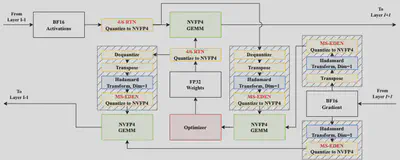
To solve this, the authors introduce MS-EDEN, a novel unbiased quantization routine specifically designed for micro-scaled formats.
- Reduced Error: MS-EDEN provides more than 2x lower quantization error than traditional stochastic rounding (SR).
- Quartet II Integration: MS-EDEN is seamlessly integrated into a new fully-NVFP4 quantization scheme for linear layers, aptly named Quartet II.
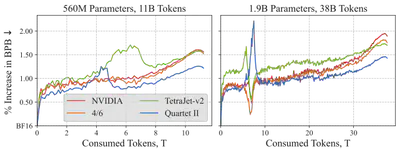
Analytically, Quartet II achieves consistently better gradient estimation across all major matrix multiplications—in both forward and backward passes. Furthermore, the proposal pairs exceptionally well with other recent performance enhancements aimed at NVFP4.
Results
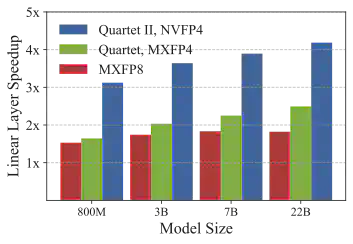
- Supplied kernels for execution on NVIDIA Blackwell GPUs demonstrate an impressive up to 4.2x speedup over equivalent BF16 implementations.
Links
Disclaimer: This blog post was automatically generated from the arXiv paper.

Andrei Panferov
PhD Candidate in Computer Science
I work on efficient large language models, with a focus on low-precision training, quantization, and scaling laws.