Quartet: Native FP4 Training Can Be Optimal for Large Language Models
The Low-Precision Training Challenge
When training large language models (LLMs), moving to low-precision offers a compelling way to improve throughput and energy efficiency. NVIDIA’s recent Blackwell architecture even provides hardware support for very low-precision operations using FP4 variants.
However, existing algorithms for training in FP4 face severe accuracy degradation. To compensate, they often fallback to mixed-precision, effectively leaving performance on the table.
Key Observations
Instead of mixed-precision workarounds, we investigate end-to-end, native FP4 training. Through extensive evaluations on Llama-type models, we explored how to keep all major computations (linear layers) in pure low precision.
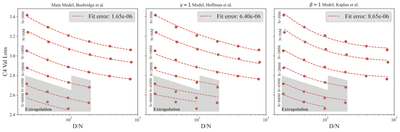
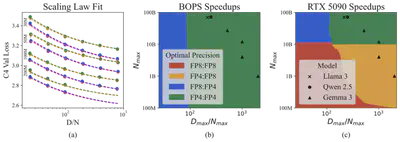
We reveal a new low-precision scaling law that precisely quantifies the performance trade-offs across different bit-widths and training setups.
Introducing Quartet
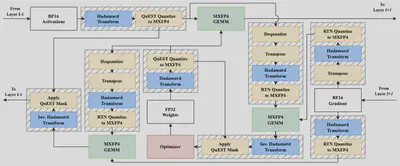
Guided by this scaling law, we formulated Quartet — an optimal technique for balancing accuracy and computation in FP4.
We implemented Quartet using custom, optimized CUDA kernels tailored for the Blackwell architecture. What we discover is that fully FP4-based training can be a highly competitive alternative to both FP16 half-precision and FP8 training, closing the accuracy gap without sacrificing speed.
Read the Paper →
Code and Implementation →
Disclaimer: This blog post was automatically generated from the arXiv paper.

Andrei Panferov
PhD Candidate in Computer Science
I work on efficient large language models, with a focus on low-precision training, quantization, and scaling laws.